

Bond yields are rising against a backdrop of persistent inflation, marked by geopolitical instability, deteriorating public finances and economic growth that remains resilient. At the end of September, sovereign bond rates reached levels not seen in decades: the 10-year US Treasury yield exceeded 5.25%, the German Bund reached 3.6% and the 10-year Japanese bond hit 3%.
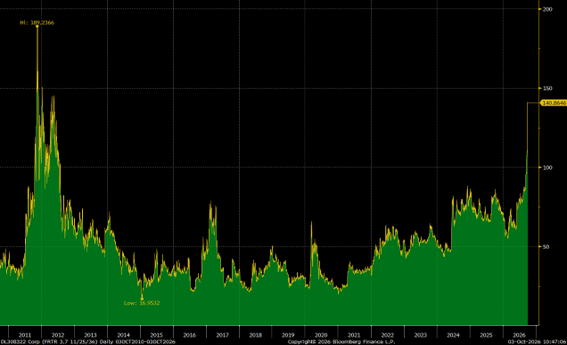
In this context, the spread between French bonds — known as OATs — and the German 10-year Bund widened to 140 bp, approaching the highs seen in 2011, when the eurozone debt crisis forced the ECB to intervene. The market is once again questioning France’s political risk and fiscal position, amid elevated deficits, weak growth and rising debt. The Bund, meanwhile, continues to act as a safe-haven asset owing to its greater perceived safety and liquidity.
10-year OAT-Bund risk premium trend:
Could the ECB step in again?
There is no predetermined level for the OAT-Bund spread that would automatically trigger an intervention by the ECB. The main tool available is the TPI (Transmission Protection Instrument), created in July 2022, which enables the Eurosystem to purchase a eurozone country’s sovereign debt on the secondary market when its financing conditions deteriorate in a way the ECB deems unwarranted and disorderly, and which also threatens the transmission of monetary policy.
One of the criteria for activating the TPI is that the country in question must comply with sound and sustainable fiscal and macroeconomic policies. In France’s case, the fact that it is subject to an EU excessive deficit procedure makes any potential ECB intervention difficult to justify under this framework, unless broader contagion to other eurozone sovereigns were to be observed.
What is France’s fiscal position?
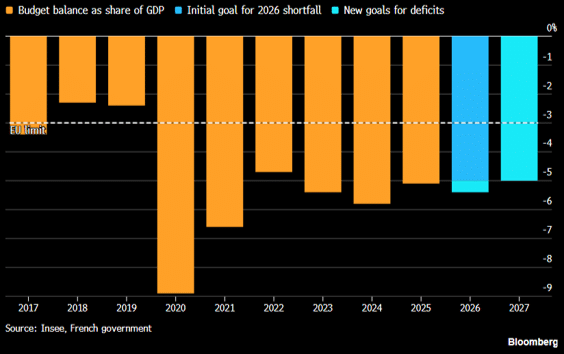
France failed to meet its 5% deficit target for 2026, coming in at 5.4% of GDP. Debt interest payments could increase from 2% of GDP to 3.6% by 2031. The debt-to-GDP ratio has exceeded 110% and could reach 140% by 2036 if stabilising measures are not put in place. These figures have led to credit rating downgrades to A+ by Fitch and S&P (Moody’s is likely to downgrade to the same level at its next review).
The French government has presented plans to reduce the budget deficit through spending restraint and higher tax revenues, with new measures valued at EUR 43 billion aimed at cutting the fiscal deficit to 5% of GDP by 2027, with the stated goal of reaching the 3% commitment by 2029. The plan is expected to be difficult to pass in a divided parliament that has already claimed several prime ministers.
Trend in France’s deficit as a share of GDP and the 5% target for 2027:
What is the market’s view?
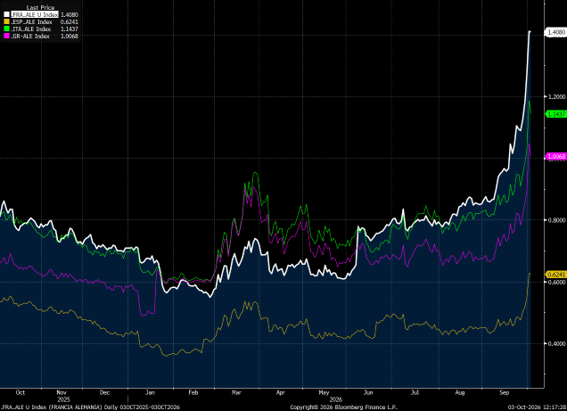
The perception of risk surrounding French debt is deteriorating, and the market is penalising France for its high level of indebtedness. So far this year, its debt has performed the worst among European sovereign bonds, showing a persistent sell-off even on days of broad-based recovery in global fixed income. France’s risk premium currently stands above that of Italy and Greece.
Trend in the 10-year risk premium spread between France, Italy, Spain and Greece versus Germany
Uncertainty is mounting amid the failure to meet deficit targets, political deadlock and next year’s presidential election, which could significantly alter the country’s economic direction. A potential catalyst for an improvement in French bond performance would be growing market conviction that political and fiscal risks are set to ease. In this regard, October’s budget negotiations will be key in determining whether idiosyncratic risk is beginning to moderate.
Date of report: October 9th of 2026