

When oil prices rise, someone ends up paying the difference. Sometimes it’s the driver who sees it at the pump every time they fill the tank. Other times it’s the state which gives up part of its tax revenue to keep prices from soaring. And if that relief is financed with debt, the bill doesn’t disappear; it simply sits waiting in the budgets of the years ahead. Much of what has happened across the Americas in 2026 comes down to how each country has chosen to split that bill.
Almost no one saw it coming. WTI, the continent’s crude benchmark, started the year near US$60 and has since climbed close to 65%, driven by the conflict in the Middle East and the difficulties of navigating the Strait of Hormuz. The region’s budgets had been built around a much cheaper barrel, so each government had to decide how much of that increase to pass on to its citizens.
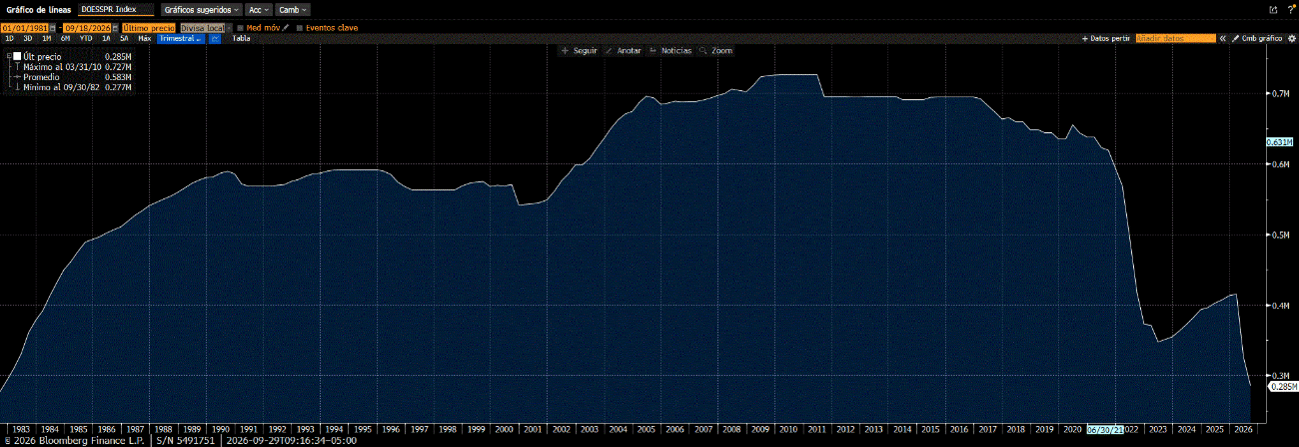
U.S. Strategic Petroleum Reserve
Source: Bloomberg, as of 09/29/2026.
The United States, the world’s largest oil producer, once again had to tap its Strategic Petroleum Reserve to temper the price surge, bringing reserves down to their lowest level since 1982.
For reference, a gallon of gasoline now costs around $4.50, compared with roughly US$3.20 a year ago, and diesel has broken its 2022 record, approaching $6.50. Overall prices have felt the impact: inflation ended August at 3.4%, with gasoline 30% more expensive than a year earlier.
With the economy still growing and a solid labor market, the Federal Reserve had room to act, and it did. In September it raised rates to the 3.75%–4.00% range, its first hike in more than three years. In addition, the median of its projections places the peak rate at the end of 2026, leaving the door open to another move.
Where the shift has been felt most, however, is in bonds. The yield on the 10-year U.S. Treasury has risen above 5.25%, a level not seen in almost two decades. When you stop to think about it, this makes a good deal of sense. Anyone lending their money for ten years wants to make sure inflation doesn’t eat into their return along the way, and with energy pushing higher, they demand more in exchange. Add to that a market already pricing in a more hawkish Fed and growing concern over the size of the federal debt.
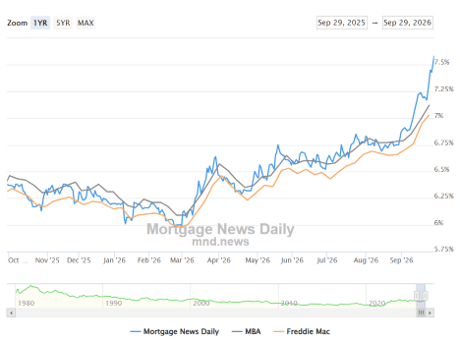
That bond is the foundation on which nearly all credit is built. The average 30-year mortgage rate has climbed above 7.5%, up from 6.30% a year ago, and companies seeking financing face a similar landscape.
Average 30-Year Mortgage Rate in the U.S.
Source: www.mortgagenewsdaily.com/mortgage-rates/30-year-fixed
For Latin America, all of this carries a very concrete implication. Countries in the region borrow by paying a spread over U.S. Treasuries, so when Treasury yields rise, their debt becomes more expensive too. The governments that held down fuel prices by taking on debt did so when everything pointed to lower rates, and today that debt costs more than expected. The bill that once seemed invisible is starting to show up in interest payments, and its final size will depend on how long oil stays at these levels.
Date of report: October 9th of 2026