
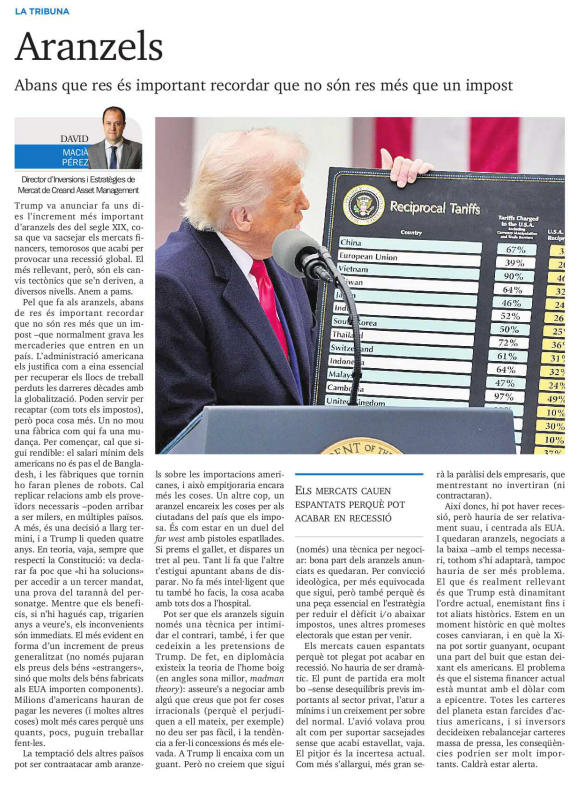
A few days ago, Trump announced the largest increase in tariffs since the 19th century and shook the foundations of the financial markets, which fear that his decision will ultimately lead to a global recession. However, the most important issues are the tectonic changes stemming from it at different levels. Let’s take a closer look.
With regard to the tariffs, first and foremost it’s important to remember that they’re none other than a tax that’s normally levied on goods entering a country. The American administration is justifying them by claiming that they’re a key tool to recovering the jobs lost in recent decades due to globalisation. They can be used to raise revenue (like all taxes), but little else. Moving a factory isn’t like moving house. To begin with, it needs to be profitable; the minimum wages in the US and Bangladesh aren’t the same, and the factories that return to the US will be full of robots. The relationships with the necessary suppliers need to be replicated, and there may be thousands in multiple countries. Moreover, it’s a long-term decision and Trump has less than four years left. At least in theory, as long as he abides by the constitution; he recently declared that “there are solutions” to allow for a third term, proof of the man’s character. While the benefits, if there are any, will take years to unfold, the drawbacks are immediate. The most obvious ones take the form of a price increase across the board (not only will the prices of “foreign” goods rise, many of those manufactured in the US import components). Millions of Americans will have to pay higher prices for fridges (and many other items) to enable a few to work by making them.
The temptation for other countries may be to counter-attack with tariffs on American imports, making matters even worse. Once again, a tariff makes things more expensive for the citizens of the country that imposes them. It’s like being in a duel in the wild west with faulty pistols. If you pull the trigger, you shoot yourself in the foot. It doesn’t matter if the other person is aiming at you before firing. It doesn’t make sense for you to shoot too, as both of you will end up in hospital.
The tariffs may just be a tactic to intimidate Trump’s opponents and make them give in to his demands. In fact, in diplomacy there is the “madman theory”, namely that sitting down to negotiate with someone you believe may do irrational things (because, for example, he’ll harm himself) can’t be an easy task, and the tendency to make concessions is greater. It fits Trump like a glove. But we don’t think it’s (just) a negotiating tactic, as a large number of the tariffs will remain. Out of ideological conviction, however mistaken it may be, but also because it forms an essential part of the strategy to reduce the deficit and/or cut taxes – other electoral promises that are yet to be fulfilled.
The markets are afraid because it could all end with a recession. It shouldn’t be anything that dramatic. The starting point was really good; no major prior imbalances in the private sector, low unemployment and above-normal growth. The plane was flying high enough to withstand any jolts without crashing. The worst thing is the current uncertainty. The longer it lasts, the greater the paralysis of entrepreneurs, who won’t invest (or recruit) for the time being.
So there may be a recession, but it should be relatively mild and focused on the US. There will be tariffs that are negotiated downwards, but everyone will adapt to them in due course and they shouldn’t be a major problem. What’s really important is that Trump is shattering the current order and antagonising traditional allies. We’ve reached a historic moment that will bring numerous changes and potentially lead to China emerging victorious and occupying part of the void that the Americans are leaving. The problem is that the current financial system is set up with the dollar as its epicentre. Every portfolio on the planet is filled with American assets, and if investors decide to rebalance them too quickly, the consequences could be very significant. We’ll have to stay alert.
Diari d’Andorra 23.04.2025