
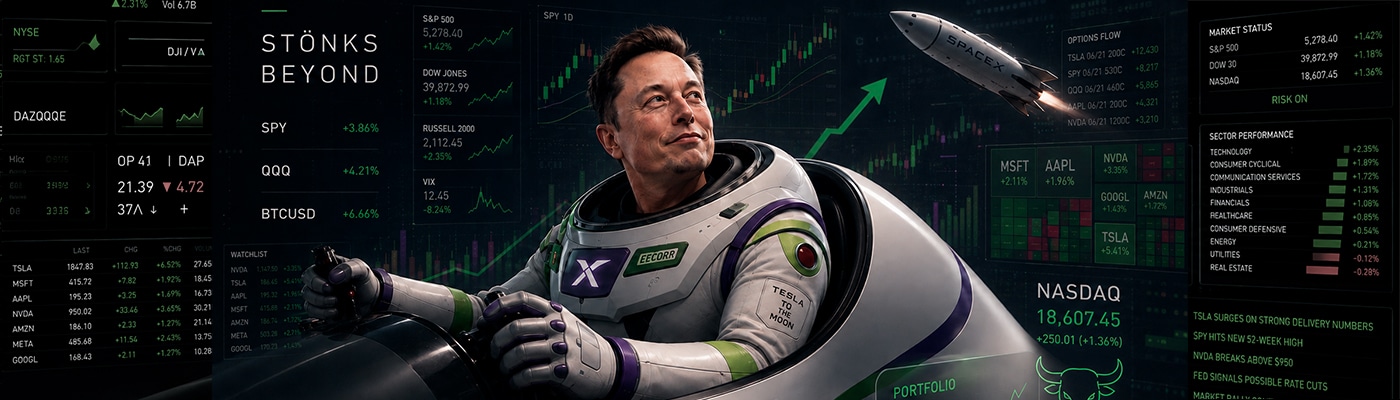
Those with young children (along with more than a few adults who are fans of Pixar films) have probably already been to see the fifth (yes, the fifth!) instalment of the Toy Story franchise. Once more we see Buzz Lightyear deliver his iconic catchphrase: “To infinity… and beyond!”. This could just as easily serve as the slogan for today’s financial markets, which seem to continue climbing relentlessly, unfazed by whatever events come their way. The quarter’s defining moment was undoubtedly the IPO of SpaceX. Reading the prospectus feels indistinguishable from reading a science fiction comic: data centres in orbit, space travel, colonies on Mars, mining operations on asteroids… One thing that cannot be questioned is the scale of the ambition. Equally stratospheric were the valuations at which the shares were offered. But when the mothership is under the command of Captain Elon Musk—the world’s first trillionaire—anything seems possible. We’ll see. Or perhaps not; we may be waiting quite a while.
None of this is much more than an anecdote. Yet, to my mind, it reflects financial markets that have been gripped by euphoria for rather too long. This is not because there are any serious weaknesses in the fundamentals. The macroeconomic backdrop remains robust (particularly in the US), employment is close to full in most economies, and in some cases growth continues to be supported by fiscal stimulus and substantial infrastructure investment that should provide lasting benefits. Enormous sums are being invested in data centres, while significant spending will also be required to electrify the economy (particularly in Europe, where energy independence is imperative), strengthen defence capabilities and accelerate automation, as ageing populations leave little alternative. Corporate earnings (again, especially in the US) continue to perform exceptionally well. Meanwhile, geopolitical events have so far proved remarkably inconsequential from a market perspective. Neither the introduction of tariffs a year ago nor the months-long closure of the Strait of Hormuz has had any meaningful macroeconomic impact to date. Moreover, oil prices have fallen sharply, confounding the consensus among experts, who had predicted they would remain elevated for at least eighteen months after normal conditions resumed. But there has been nothing resembling a return to normal. Only around a third as many ships are transiting the strait as before, and occasional missiles are still flying one way or another. Yet markets appear entirely untroubled. Crude oil prices have tumbled and, in reality, inflation should continue to moderate. This leaves central banks with little reason to contemplate further interest rate rises—which is one development that genuinely does tend to unsettle financial markets.
Yet SpaceX, as we were saying, is symptomatic of something else. Many financial assets are now driven by retail investors, and markets increasingly appear to move on waves of momentum. Much of the success of SpaceX’s IPO can be attributed to the legions of followers who back Elon Musk with unquestioning conviction. Those same crowds—or at least crowds very much like them—were buying Bitcoin not so long ago (now around 50% below its peak). Then it was gold. Now it is semiconductors (in South Korea, SK Hynix rose by 225% in the second quarter alone, fuelled by domestic retail investors). From one fad to the next, with investors eagerly following the latest market narrative.
The point is not to argue whether buying Bitcoin, gold or semiconductors is a good idea. Rather, it is to emphasise that, however strong the fundamentals may be, excessive enthusiasm is rarely a good thing. The silver lining is that financial markets have become more polarised than they have been for many years. Assets associated with the investment narrative currently capturing investors’ attention—in this case, artificial intelligence—have seen their valuations soar. Everything else outside that narrative has struggled, whether deservedly or not. In our view, that “everything else” is where the opportunity lies. This is not to suggest buying assets simply because they have performed poorly— that would be a recipe for disappointment. Instead, it means paying close attention to what is not working. A good investment is not simply a good idea; it is a good idea at the right price. By definition, that second ingredient is far harder to find where everyone is buying than where everyone is selling. Unless, of course, your name is Elon.
Date of report: July 8th of 2026