
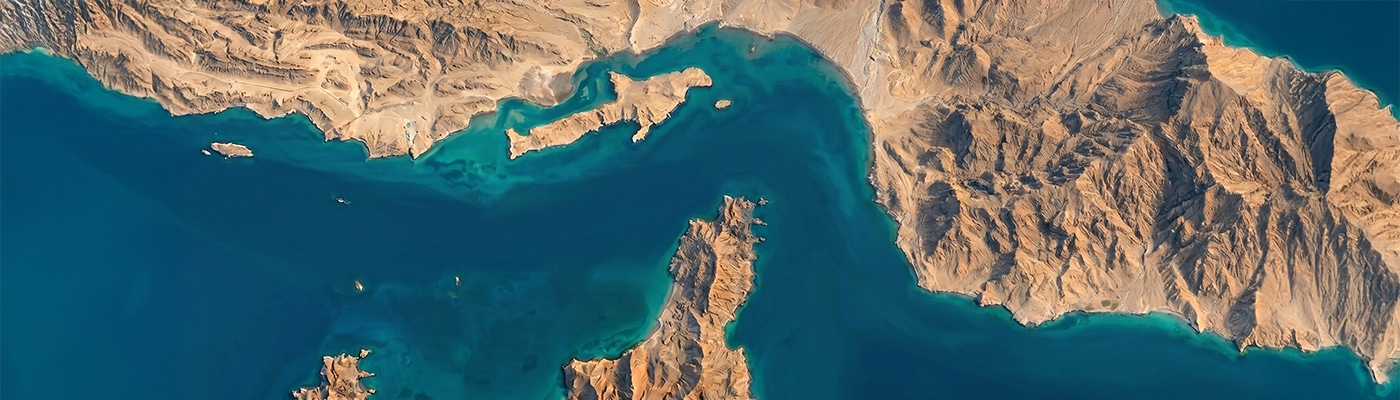
If you ask your favourite AI which are the most important places in the world, it will almost certainly tell you that it depends on the criteria: historical significance (the Pyramids of Giza and Machu Picchu invariably feature), religion (Mecca, Vatican City), science (CERN, Silicon Valley), finance (Wall Street, the City of London), travel (the Eiffel Tower, the Sagrada Família) or politics (the White House, Beijing). Yet none of them—at least none that I have tried—answers that today, without any doubt, the most important place in the world is a narrow stretch of sea just 33 kilometres wide between Oman and Iran: the Strait of Hormuz. Donald Trump must have assumed that dismantling the Iranian regime would be straightforward when he authorised “Operation Epic Fury” (one cannot deny him a certain creativity in naming). A month and a half on, as these lines are being written, neither oil, gas nor the derivatives the world so badly needs are getting through. By the time you read this, an agreement may well have been reached. Trump is in a hurry to bring this episode to a close, as his party is facing midterm elections in November with a very unfavourable outlook.
Even so, we can venture a few observations with relatively little risk of being wrong. First, once an agreement is reached, returning to “normality” will take time: infrastructure must be repaired, freight insurance costs brought back down, new vessels allowed in and out to clear accumulated inventories, production restarted, and crude refined (oil in its raw form is of little use on its own). Second, it is highly likely that the Iranian regime will remain in control, albeit with more hardline figures at the helm, which will increase regional instability over the medium term. Third, crude prices are likely to remain elevated for some time. This conflict has achieved little (at least nothing positive). Iran has effectively been shown to be far more powerful than it previously believed: merely threatening to block passage through the Strait of Hormuz—without even having to do so in practice, given the reluctance of any vessel to attempt the crossing—is enough to hold the rest of the world in check. It is therefore only logical that crude should trade at a higher premium than in the past. Most countries will seek to replenish their reserves as soon as conditions allow, driving a surge in demand, while supply will take considerably longer to normalise. Fourth, financial markets appear largely indifferent. They tend to overlook geopolitical events, and this episode has been no exception: declines have been minimal given the scale of developments. Should the situation be resolved swiftly, this reaction even appears fundamentally reasonable. We are coming from a robust macro environment, which continues to show resilience despite the turmoil. On the one hand, by fiscal stimulus that is about to be deployed in several parts of the world (Germany, Japan and the United States itself). On the other, by very substantial investment—much of it seemingly non-negotiable and independent of the cycle (in AI, defence, automation or electrification—understood in Europe as a matter of energy independence).
The risk for investors is inflation. If it takes hold and central banks raise rates, the party will be over. In our view, they should refrain from doing so. Central banks cannot print oil, and higher crude prices are, in effect, a tax on income that weighs on growth. Raising rates will not reopen the Strait of Hormuz; it will simply heighten the risk of recession. Perhaps a greater risk is that starting valuations were already very generous, at index level, across almost all asset classes (fixed income, equities and alternatives). The good news is that dispersion is HUGE (in big capital letters, in the style of Donald Trump in one of his social media posts). This means that, even if indices look expensive, there are many very attractive opportunities (A LOT!) to buy specific assets that are very (VERY!) cheap, for the patient investor. As I like to remind you in every note: if you are not patient, you are not investing—you are speculating.
Let us hope that we can soon stop talking about Hormuz and instead turn to places such as Disneyland Paris or the Maldives—or anywhere else whose mere mention evokes a sense of peace and happiness.
Date of report: April 20th 2026