
In the world of finance, few concepts generate as much debate as the Efficient Market Hypothesis (EMH). This theory is more than a mere intellectual exercise. Indeed, depending on the view you adopt, investment strategy can vary significantly, from the passive purchase of index products to the active search for opportunities through data analysis.
The theory: Prices offer a complete reflection
EMH holds that, in a perfectly efficient market, the price of an asset reflects all available information, both public and private. In such a scenario, if a company announces unexpected results, the price adjusts instantly. As a result, achieving extraordinary returns or “beating the market” consistently would, in theory, be impossible.
If we accept this premise, the best strategy is passive investing. Rather than trying to uncover the “next hidden gem”, simply buy the product that tracks the entire market (such as an index fund) and let global economic growth do the work.
The alternative: The art of finding bargains
In contrast to this view, value investing emerges as an alternative. This is the strategy that brought Warren Buffett to prominence. The philosophy behind value investing rests on a fundamental distinction: price is not always the same as value.
Value investors seek solid companies that, due to temporary concerns, market overreactions or a lapse in attention, are trading below their true value. The aim is to buy “cheap” and wait for the market to recognise the real value of the businesses over time, and for the price to rise accordingly.
The reality: The human factor
We must ask, if the market is so perfect, why do bubbles or sudden crashes occur? This is where psychology comes in. Markets are not sterile, immutable machines; they are made up of people who experience fear and euphoria and who follow trends blindly.
This irrational element creates anomalies. One well-known example is the “January effect”, where stocks historically tend to rise at the start of the year. Another one could be the fact historically, small-cap stocks often outperform larger companies. Even the very existence of technical analysis suggests that markets are frequently not fully efficient, as patterns of human behaviour tend to reappear in the charts.
The key role of the financial adviser
Despite these cracks in the theory, the evidence is clear. Over the long term, consistently outperforming the market is extremely difficult. However, this does not mean that the role of the portfolio manager or financial adviser is redundant.
Today, the aim of a good professional in our industry is not necessarily to “predict” the market’s next move, but rather to act as an architect of wealth. The real value of an adviser lies in building a portfolio aligned with the client’s life goals, managing emotional risk to prevent impulsive selling during moments of panic and, above all, optimising tax efficiency and diversification. In a world of often irrational markets, sound judgement and careful planning are, without doubt, the best source of financial returns.
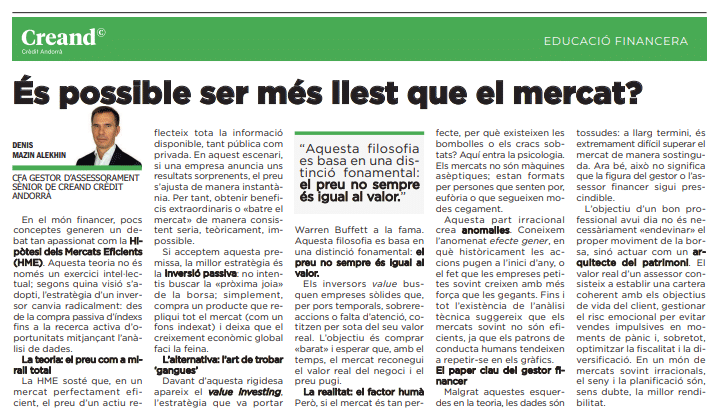
Diari d’Andorra, 17.3.2026