
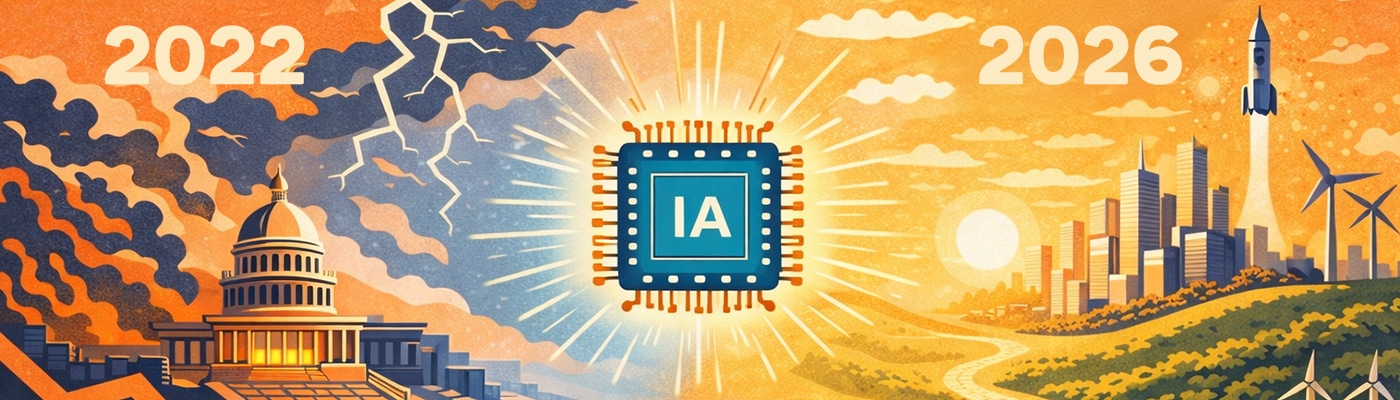
We are steadily moving on from 2022, the last year in which we saw falls in financial markets (in fact, close to 20% across almost everything; there was nowhere to hide). At the time, investors were spooked by the battle central banks were waging against runaway inflation. Technology stocks—the big winners of the pandemic for accelerating the arrival of a digital future—slumped heavily (the so-called “Magnificent Seven” lost as much as half of their value). By the end of that year, there was complete unanimity: rising interest rates would make a recession in 2023 inevitable.
Then ChatGPT burst onto the scene, something of a holy grail for Nvidia and its peers, reigniting enthusiasm. And there was no recession at all. I studied economic science several decades ago, and if there is one thing time has taught me, it is that calling economics a “science” is quite generous. As long as it is driven by human beings (until we are all replaced by robots), it will resemble us: unpredictable. Niels Bohr once said “prediction is very difficult, especially about the future”, referring to quantum physics (had he been an economist, it might have driven him mad).
Three years on, investors are still celebrating. And there are plenty of reasons. Unemployment is at historic lows across much of the world, inflation appears to be easing gradually and central banks are cutting rates, or have already done so. Not even Donald Trump’s assault on the established order, stitching together tariffs and threats for friend and foe alike, seems to have had much impact on anything. The Federal Reserve will soon have a new chair, whose prospective occupant will need to pledge allegiance to the Oval Office if they wish to secure the job. At the same time, fiscal stimulus is arriving in the form of the “One Big Beautiful Bill” approved a few months ago, completing a trifecta of impulses (fiscal, monetary and deregulation) that should further juice up the system. Something similar should happen in Europe, with Germany in the midst of a full-blown fiscal Copernican shift. With the exception of deregulation, of course. If Europeans are world champions at anything, it is very much the opposite of that. Finally, let us not forget that artificial intelligence could propel growth and productivity, lower inflation and even improve cholesterol levels. (Note: this last point is, objectively speaking, the most likely of all the above, given AI’s potential to accelerate the development of new pharmaceuticals. Historically, the impact of technological revolutions follows a “J-curve” and takes a long time to become truly significant).
Some will argue that it is better not to buy after three consecutive years of double-digit gains. Even that does not seem a particularly convincing excuse. First, because those three years only apply if your base currency is the dollar and your benchmark is the S&P 500. US equities rose by just over 2% last year, if we choose to measure them in euros. And second, because those three years are just a statistic — worth exactly what such statistics are worth. Besides, it is not all that extraordinary. The cumulative gain over those three years (in dollars and in US equities, just to make it sound better) is “only” the tenth best on record. In the nine instances that beat it, we were either in full bubble mode, recovering from a previous thumping, or things ended badly the following year. But that, too, is just another statistic.
So, all things considered, let the celebrations continue. And long may they last. For those of us who suffer from chronic scepticism (everyone else may stop reading here), 2025 bears a certain resemblance to 2022, only in reverse. Once again, there is absolute unanimity (2026 will be fantastic; 2023 was supposed to be a disaster), and it is hard to dispute — the arguments are, after all, very good. And yet some malfunctioning neuron refuses to be entirely convinced. Perhaps it is valuations (particularly in US equities and credit), which leave little room for anything to go wrong. Perhaps it is the sheer scale of deficits and public debt, which is increasingly uncomfortable. Or perhaps it is simply that too much money tends to go the same way (ETFs dominate flows, so far in only one direction). In any case, the alternative cannot be to stash our money under the mattress. Inflation is the moth that eats away at savings. We all go to the supermarket — I assume there is no need to say any more. So what are we to do? Invest, but prudently. We must accept risk but combine higher-risk strategies with others offering far more modest potential returns, while providing the liquidity needed to take advantage of opportunities as they arise. Multi-asset vehicles can be an excellent solution (they will do the buying themselves when opportunities appear). And be very selective. Good opportunities are plentiful, but they require digging and patience (often they exist precisely because others do not want them, usually for short-term reasons). Buying an index and “forgetting about it” has delivered stratospheric results in recent years, for reasons that seem unlikely to continue fuelling strong returns. It is already too late for that.
And make no mistake: I am not predicting any kind of disaster. For two reasons. First, because it looks like another good year. Perhaps too much like one. And second, because making forecasts, especially about the future, is very difficult. Happy 2026.
Date of report: January 7th 2026