
Banking APIs: what they offer and how to integrate them into your business
In recent years, companies have undergone a major transformation in which digitalisation and automation have become non-negotiable requirements in order to compete in a global market.
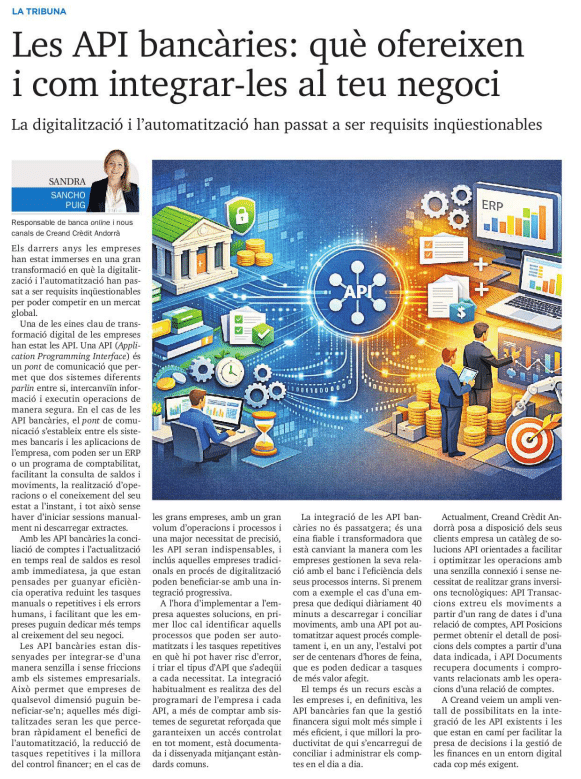
One of the key tools driving this digital transformation has been the use of APIs. An Application Programming Interface (API) serves as a communication “bridge” that allows two different systems to “talk” to each other, exchange information and execute operations securely. In the case of banking APIs, this communication bridge is established between banking systems and a company’s applications, such as an ERP system or accounting software. This then makes it possible to check balances and transactions, carry out operations or monitor their status in real time, all without the need to log in manually or download account statements.
With banking APIs, account reconciliation and real-time balance updates can be handled instantly. These APIs are designed to improve operational efficiency by reducing manual or repetitive tasks and human error, while enabling companies to devote more time to growing their business.
Banking APIs, such as those offered by Creand Crèdit Andorrà, are built to integrate easily and seamlessly with corporate systems. This means that companies of any size can benefit from them. More digitally advanced organisations will be the first to see the advantages of automation, the reduction of repetitive tasks and improved financial control. For large companies with a high volume of transactions and complex processes requiring greater precision, APIs are indispensable. Even those more traditional businesses undergoing digital transformation can benefit through a gradual, phased integration.
When implementing these solutions within a company, the first step is to identify which processes can be automated and which repetitive tasks carry a risk of error, and then to choose the type of API that best fits each need. Integration is usually carried out through the company’s own software, and each API—besides incorporating enhanced security systems that ensure controlled access at all times—is fully documented and designed using common industry standards.
The integration of banking APIs is not a passing trend; it is a reliable, transformative tool that is changing the way companies manage their relationship with the bank and improve the efficiency of their internal processes. To illustrate this, consider a company that spends 40 minutes every day downloading and reconciling transactions. By using an API, this process can be fully automated, resulting in the saving of hundreds of working hours over the course of a year—time that can be reallocated to higher value-added tasks.
Time is a scarce resource for businesses. Ultimately, banking APIs make financial management much simpler and more efficient, improving the productivity of those responsible for reconciling and managing accounts on a day-to-day basis.
Creand Crèdit Andorrà provides its corporate clients with a catalogue of API solutions designed to streamline and optimise operations through a simple connection, without the need for major technological investments. These include: the Transactions API, which extracts transaction data based on a date range and a list of accounts; the Positions API, which provides detailed account position information as of a specified date; and the Documents API, which retrieves documents and supporting records related to the transactions of a set of accounts.
At Creand, we see a wide range of opportunities in the integration of existing APIs, as well as those currently in development, to support decision-making and financial management in an increasingly demanding digital environment.
Diari d’Andorra 18.12.2025