
In 2024, one quarter of the world’s population has been called to the polls in what is shaping up to be the most intense year of elections in history. The year will culminate in one of the most consequential elections on the planet, with Kamala Harris attempting to stave off a second term for Donald Trump. The importance of this election extends beyond the controversy that is the perpetual shadow of the Republican candidate (having been found guilty on 34 counts of falsification, he would be the first convicted president in history and still faces 91 unresolved criminal charges). It also underscores the clear division in US society, which is more polarised than ever, with tensions likely to deepen no matter who wins. Either candidate’s electoral programmes is set to have a major impact on the economy and financial markets.
Trump is calling for mass deportations, completing the wall on the Mexican border and tightening access to US citizenship. This stance seems economically counter-productive, as the US has benefited from immigration. It has supplied affordable labour to a very dynamic jobs market and contributed to a population pyramid that is now the envy of most developed countries. No less dangerous are the Republican plans to raise tariffs, which, as a presidential prerogative, does not require the approval of the two Houses. Should Trump make good on his threats, tariffs could reach levels not seen since 1935, almost certainly provoking reprisals from other countries (to which Trump would likely respond, and so on and so forth). The result would be a rollback in globalisation, which has been a major driver of worldwide economic growth in recent decades.
Fiscal policy may be the area that could have the greatest implications for financial markets. Trump has pledged to lower taxes across the board, starting with corporate tax (as he did in his first term) from 21% to 15%. Harris, on the other hand, plans to raise corporate tax to 28% and increase contributions from the wealthiest taxpayers. Of equal, if not greater importance than who will be the next president is whether they will have a majority in both congressional houses. A “blue sweep”, in which the Democrats take full control, would likely be met with initial concern from equity investors, who in the end are still buying corporate profits, which are weighed down by higher taxes. The exact opposite could happen if the Republicans gain control of both Houses.
This latter scenario is increasingly likely, coinciding with a rebound in the rates on longer-term US government debt. This is no coincidence. Tax cuts would further widen the budget deficit, currently exceeding 6%—an unprecedented level outside emergency periods (primarily wars or the 2020 pandemic). Additionally, given that both Trump’s and Harris’s policies are fundamentally inflationary, the Fed’s task will be made all the more challenging, likely limiting its ability to significantly lower interest rates.
What should keep investors up at night is precisely the risk that markets may begin to overly worry about the trajectory of public deficits. Whether Trump or Harris comes out on top, the US public deficit will remain at extreme levels, which is absolutely unsustainable in the long run. Financial markets can be unforgiving in this regard. Liz Truss, the briefest occupant of 10 Downing Street, knows this all too well. Her tenure lasted barely six weeks after she pledged both increased spending and lower taxes, triggering an investor exodus. This should serve as a warning to us all, especially when it happens not in Venezuela or similar countries, but rather in a major economic power like the UK. It is perhaps no coincidence that gold continues to hit record highs. What may seem surprising is that it does so alongside gains in the S&P 500. This is an unusual pairing, as gold tends to signal distrust while the S&P 500 reflects the opposite. Many investors may be sensing that excessive fiscal and monetary policies are eroding the value of currencies.
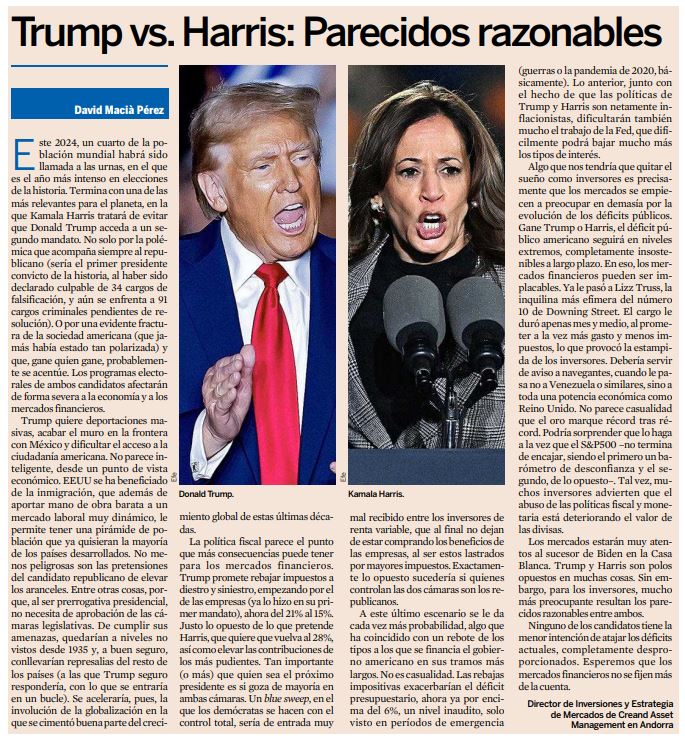
Markets will be keeping a close eye on Biden’s successor in the White House. Trump and Harris are poles apart on many issues; yet, for investors, the more troubling aspect may be the striking similarities between them. Neither candidate has shown any intention of tackling the current, utterly disproportional deficit. Let’s hope that financial markets don’t pay this too much attention.
Expansión 30.10.2024